Two Bodies
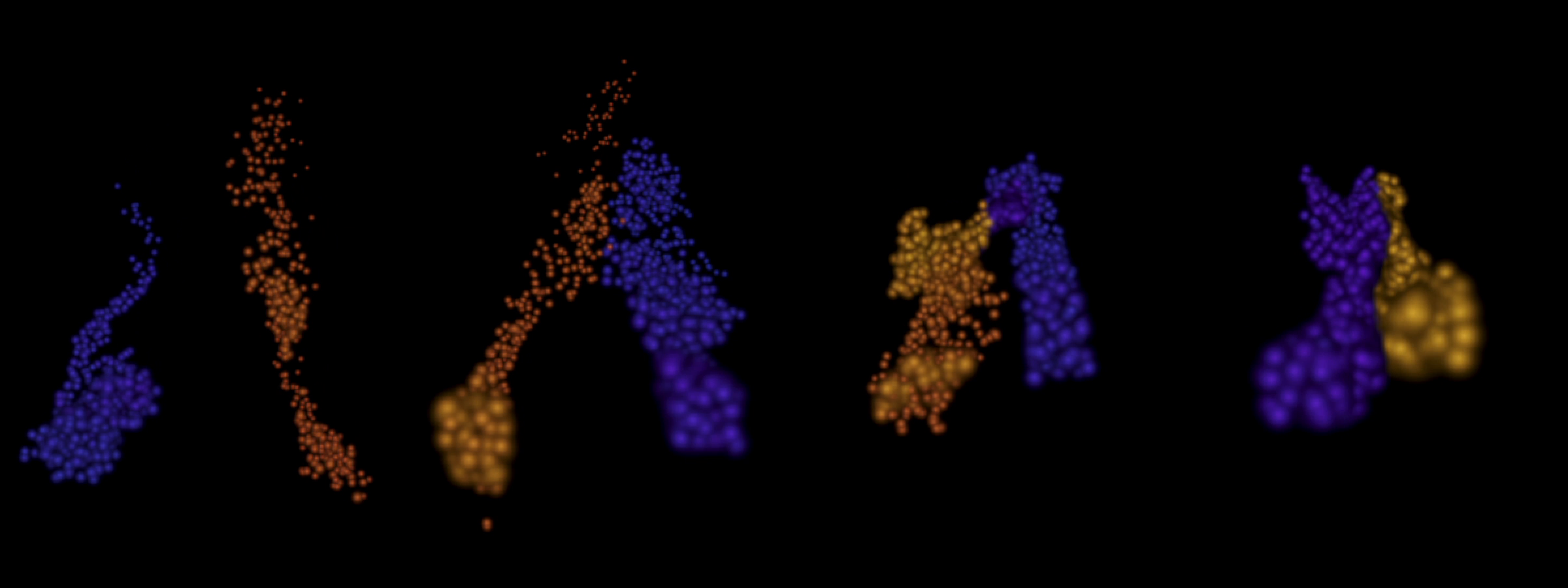
Particles as listening matter: two forms shaped by sound finding each other.
An audio-reactive particle system built in Unity, with one piece of music as its only input: Ezio Bosso’s Rain in Your Black Eyes. Two particle bodies live on opposite sides of the screen, one listening to the bass of the strings, the other to the mids of the piano. The sound shapes their size, speed, and density moment to moment, while the song’s progress carries them toward each other, into an orbit, and finally into one form.
01 Concept
Can sound be translated into form?
I wanted form that grows, evolves and transforms across a whole piece of music, more than motion that simply reacts.
This sits inside a broader question I'm investigating: how do frequency, amplitude and rhythm shape the motion, scale and material qualities of digital forms?
The music shapes every moment.
I shaped the arc.
02 How It Works
256 frequency values, every frame.
Every frame, Unity takes a snapshot of the sound as 256 frequency values. That data is the raw material for everything on screen.
INPUT
ANALYSIS
FREQUENCY BANDS
OUTPUT
reacts to bass amplitude
reacts to mids amplitude
A three-part relationship
A purely reactive system loops: the same behavior repeats wherever you are in the song. Reading the song's progress gives the piece an arc.
03 Process
From one system to two bodies.
I built the piece in layers: first particles that react to sound, then a timeline that gives the reaction an arc, then a split into two bodies with their own voices.
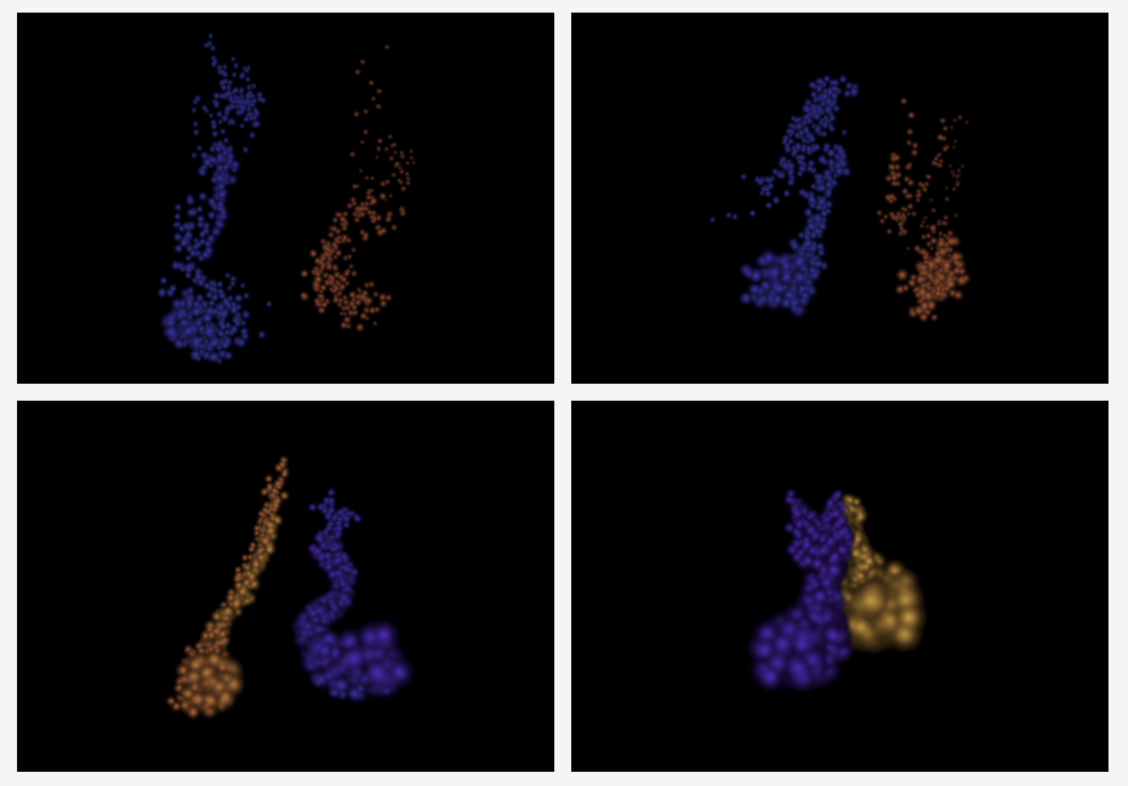
VFX Graph for the merge
VFX Graph runs on the GPU and gives each particle its own logic. It appears only from 70% of the song, during the merge. Three exposed properties receive live values from the C# script every frame.
04 Feedback
What people saw in it.
“A cool fusion of authoring and procedural form.”
Professor“So mesmerizing. A combination of art and music. This can become a piece that people can pay to watch and listen to.”
Classmates05 What I Learned
Each parameter mapping is a design decision.
What's next
Music: Rain in Your Black Eyes, Ezio Bosso