CoLabs
A cross-disciplinary innovation lab designed to teach collaboration before students enter EPD environments, addressing the root cause, not the symptom.
Role
Concept Lead & Interaction Designer · Team of 4
Methods
Stakeholder interviews · System mapping · Service design · Interaction design
Timeline
14 weeks · Srping 2026
Target
College & graduate students, desktop
Device
Desktop
Tools
Figma · Figma Make · ChatGPT
01 The Problem
There is feedback. But no clear path forward.
A student receives a grade. Maybe a short comment,"improve your storytelling." The next step is unclear. They wait for an email response. They schedule office hours that might be days away. Or they wait until the next class session to ask a question.
Instructors face the same delay. Sharing learning resources requires navigating licensing, accessibility, or administrative approval processes, all of which take time.
Feedback exists. But the system offers no immediate path forward. That delay is a service gap.
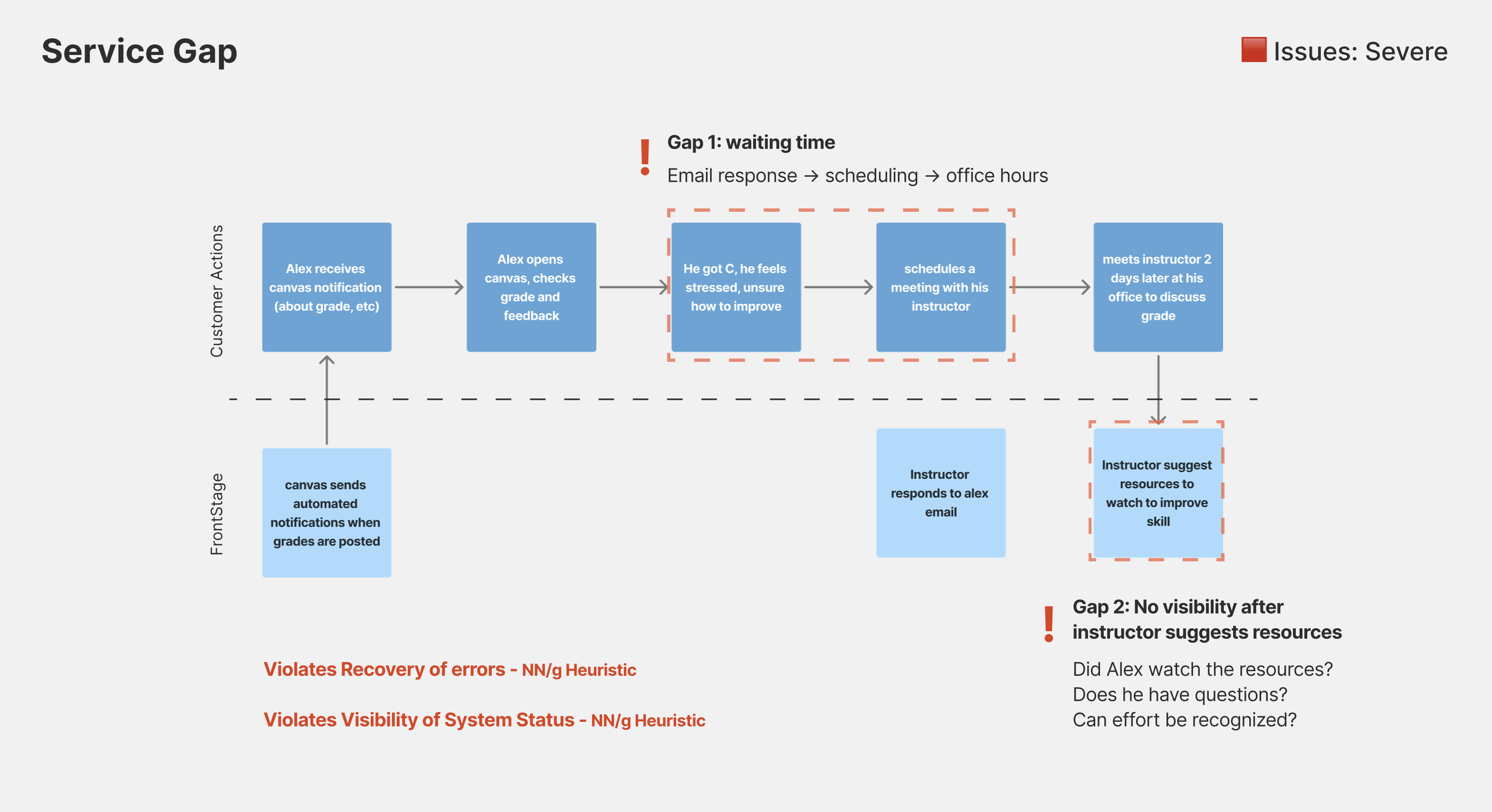
Two service gaps were identified:
Gap 1 — Waiting time
After receiving a low grade, students must wait for an email response, schedule a meeting, and attend office hours — sometimes days later — before they can take any meaningful action toward improvement.
Violates: Help users recognize, diagnose, and recover from errors — NNG Heuristic
Gap 2 — No visibility after feedback
When an instructor suggests resources, there is no way to track whether the student engaged. Did they watch the video? Do they have questions? Can their effort be recognized?
Violates: Visibility of system status — NNG Heuristic
Note on device:
This project is mobile-first. The dashboard redesign addressed the desktop because that's where students manage coursework. Canvas Learning is mobile because receiving a grade notification and taking immediate action happens on your phone
02 Research & Framing
Mapping the gap across the full service
Through student interviews and secondary research, a consistent pattern emerged. The delay between understanding a grade and knowing how to respond didn't come from a lack of effort on either side. It came from timing, fragmentation, and the absence of a clear pathway forward.
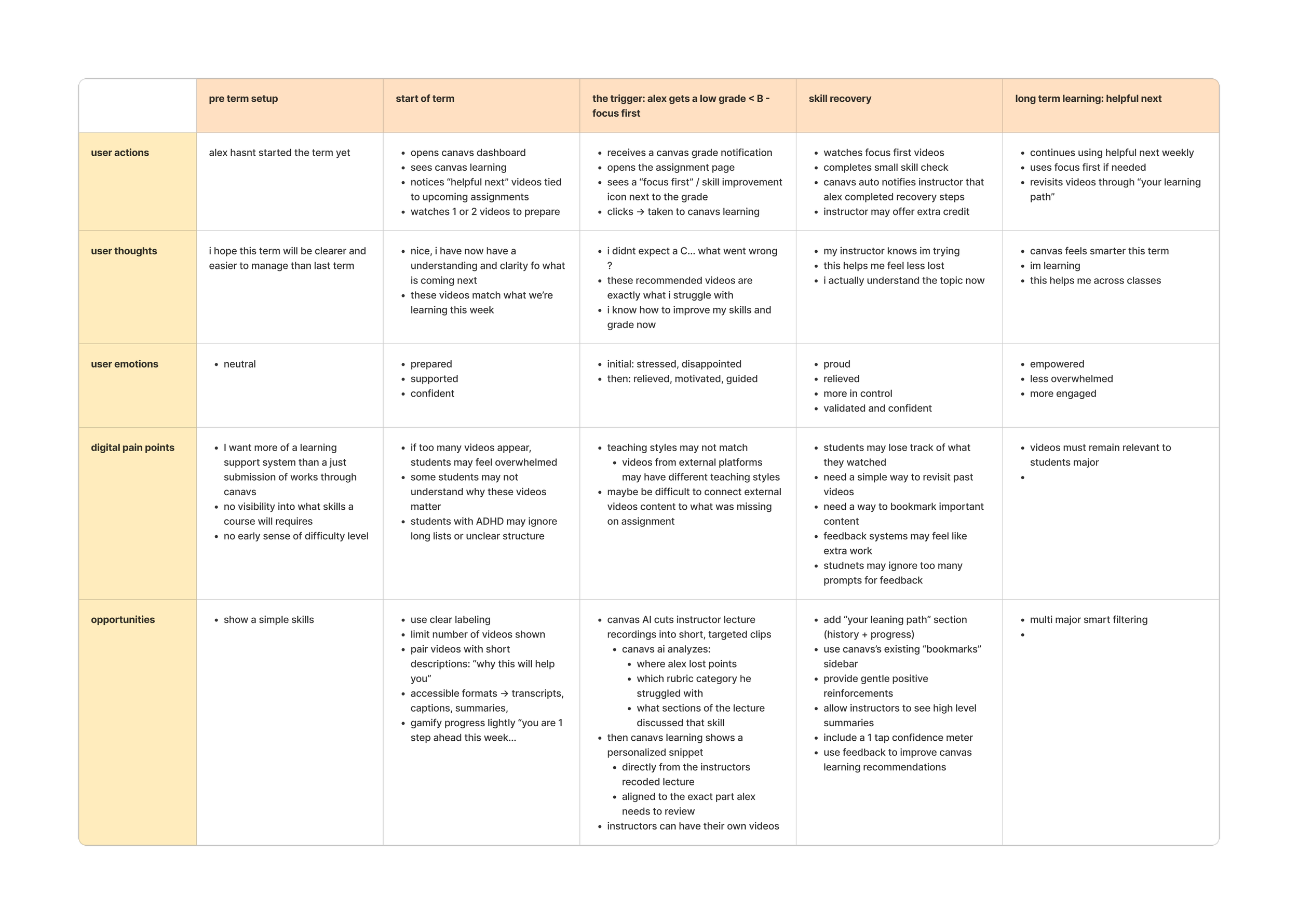
I mapped the experience across five stages, from pre-term setup through long-term learning, tracking user actions, thoughts, emotions, pain points, and opportunities at each stage.
From the research, I framed the problem through three service-level principles:
Legibility
Can students clearly understand what to do next, at the moment feedback is received?
Continuity
Does learning persist across time and moments of stress, or does it reset after each grade?
I used ChatGPT to synthesize patterns across student interviews and secondary research, and Figma Make to rapidly prototype the mobile interface.
The five stages:
Pre-term setup — before the term begins
Start of term — first weeks, expectations set
The trigger — Alex receives a grade below B
Skill recovery — Focus First content, immediate action
Long-term learning — Helpful Next, continued engagement
Agency
Can students and instructors act meaningfully without added cognitive or operational burden?
These principles operate beyond the interface. They shape the learning journey across an entire term.
03 The Service
From feedback to action, without increasing instructor burden.
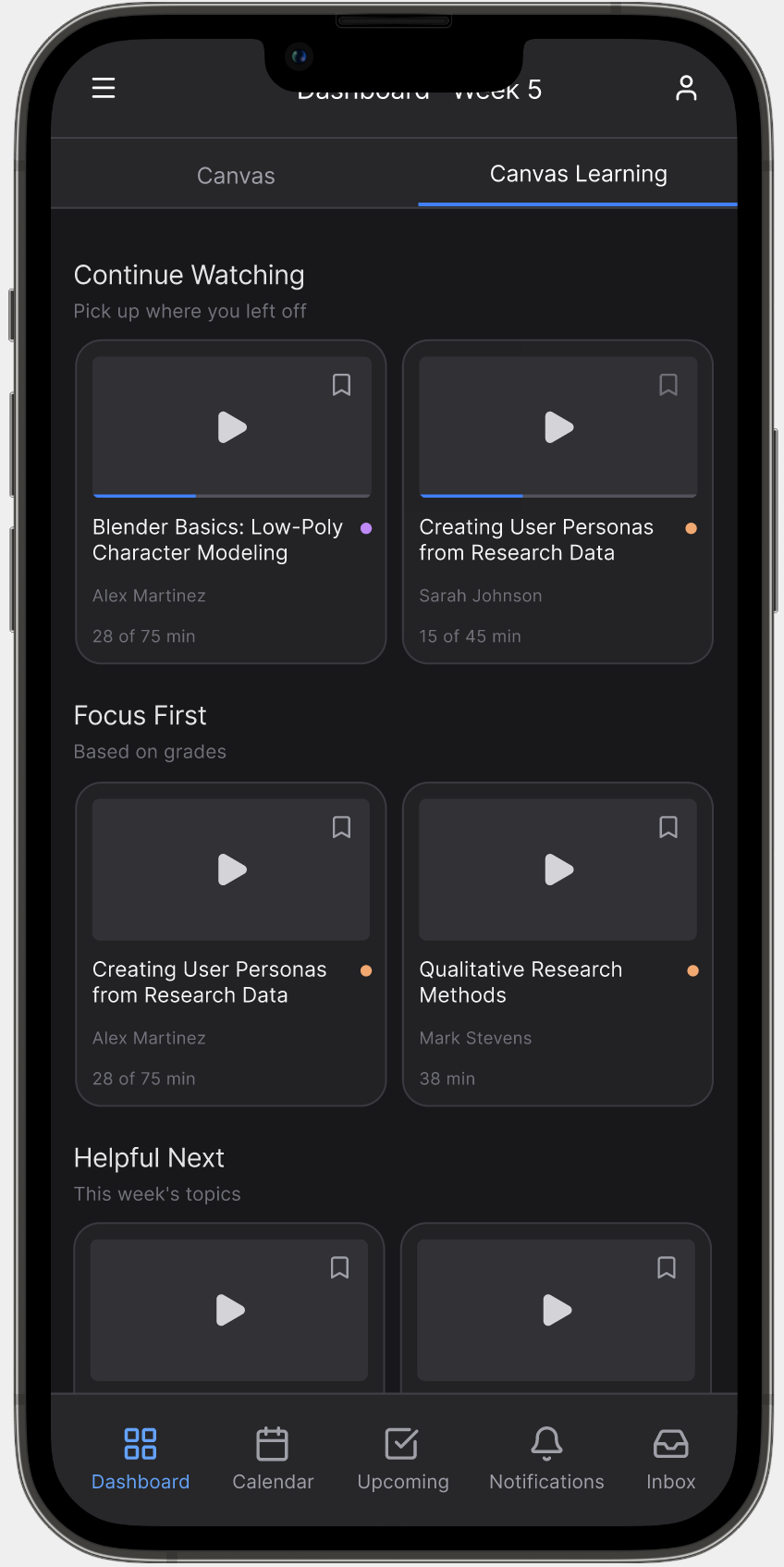
Canvas Learning is a dedicated space within Canvas that surfaces instructor-approved videos and articles, aligned with each course's syllabus, modules, and assignments.
It runs alongside the academic term, recommending skills students are learning each week. It doesn't replace live classes or instructor judgment. It supports learning between moments of human interaction.
Content is organized into three levels:
Focus First — surfaces when a grade falls below a threshold. Content tied directly to performance gaps. The skills most relevant to immediate improvement.
Helpful Next — aligned with upcoming weekly concepts. Keeps students prepared without overwhelming them.
Articles — lightweight reinforcement for students who want to go deeper at their own pace.
From Feedback to Action
Canvas Learning
From Feedback to Action
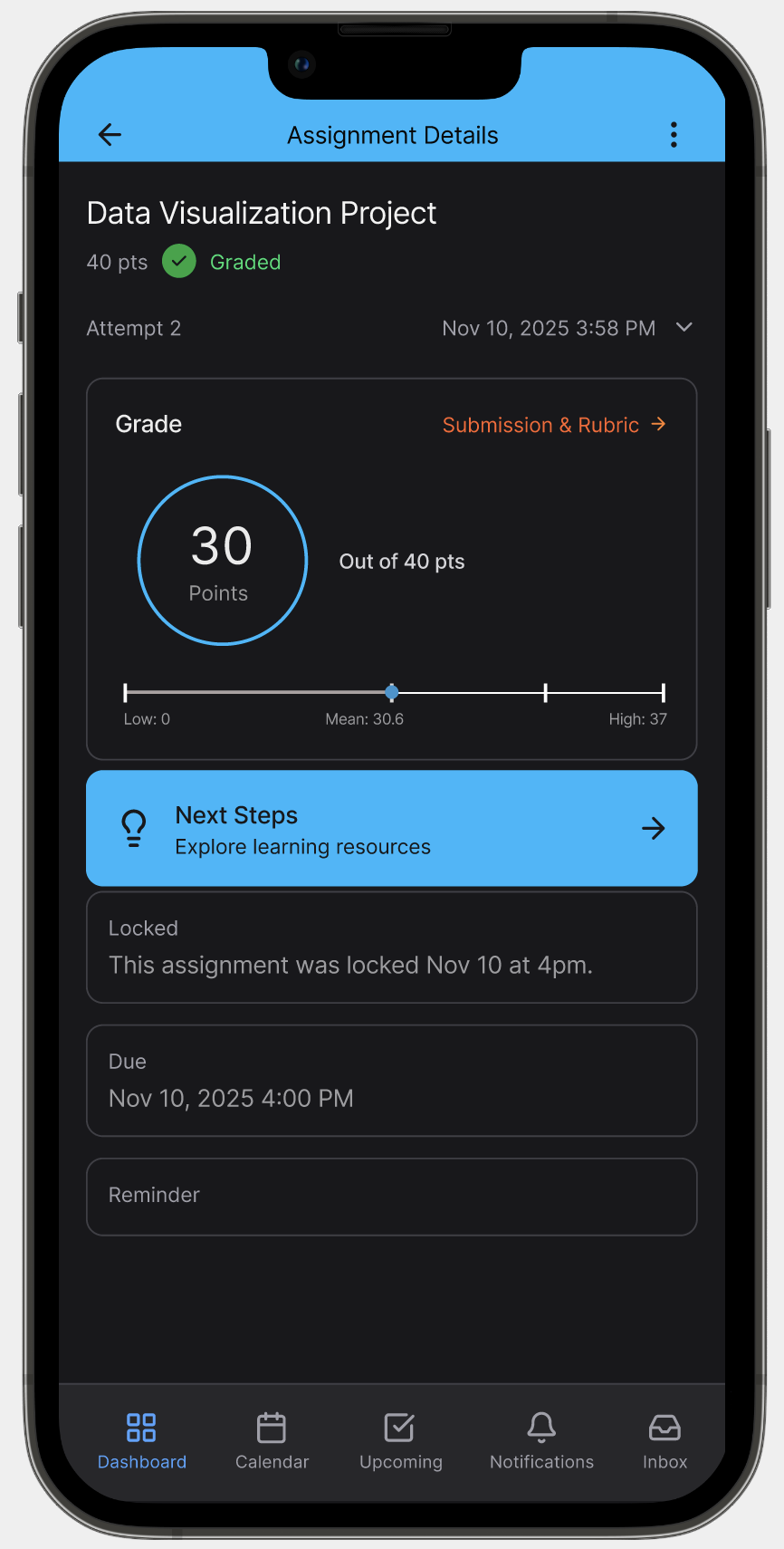
When Alex sees a low grade, he also sees a Next Steps button.
Tapping it takes him directly to Canvas Learning, where content is already organized around his specific skill gaps. No searching. No waiting. No switching platforms.
Canvas Learning doesn't grade students. It reduces waiting and helps learning continue immediately after feedback.
Instructors stay in control.
Before the term begins, instructors review and approve recommended content. They can add their own resources at any time. After that, the system handles matching, prioritizing, and tracking automatically.
When a student completes a Focus First video, both the student and instructor receive a notification. The instructor can then choose to acknowledge the effort or award extra credit
04 Service Blueprint
Behind the Scenes: How the Service Works.
This is not a single UI change. It's a service that spans student actions, frontstage system responses, backstage instructor decisions, and institutional support processes.
The blueprint maps what happens across four layers simultaneously:
Physical/digital evidence — what the student sees and touches: grade notification, skill icon, Canvas Learning tab, video cards, instructor feedback
Customer actions — what Alex does at each step, from receiving the notification to completing a video and checking his updated grade
Frontstage actions — what Canvas does visibly: posts grades, displays the Next Steps icon, shows curated recommendations, provides the video player with accessibility features
Backstage actions — what happens invisibly: notification automation triggers when grade falls below B, Canvas pushes personalized recommendations, LTI integration tracks completion, instructor is notified
Support processes — Canvas LMS administration, LinkedIn Learning LTI integration, ML recommendation engine, accessibility framework, privacy and data governance policies
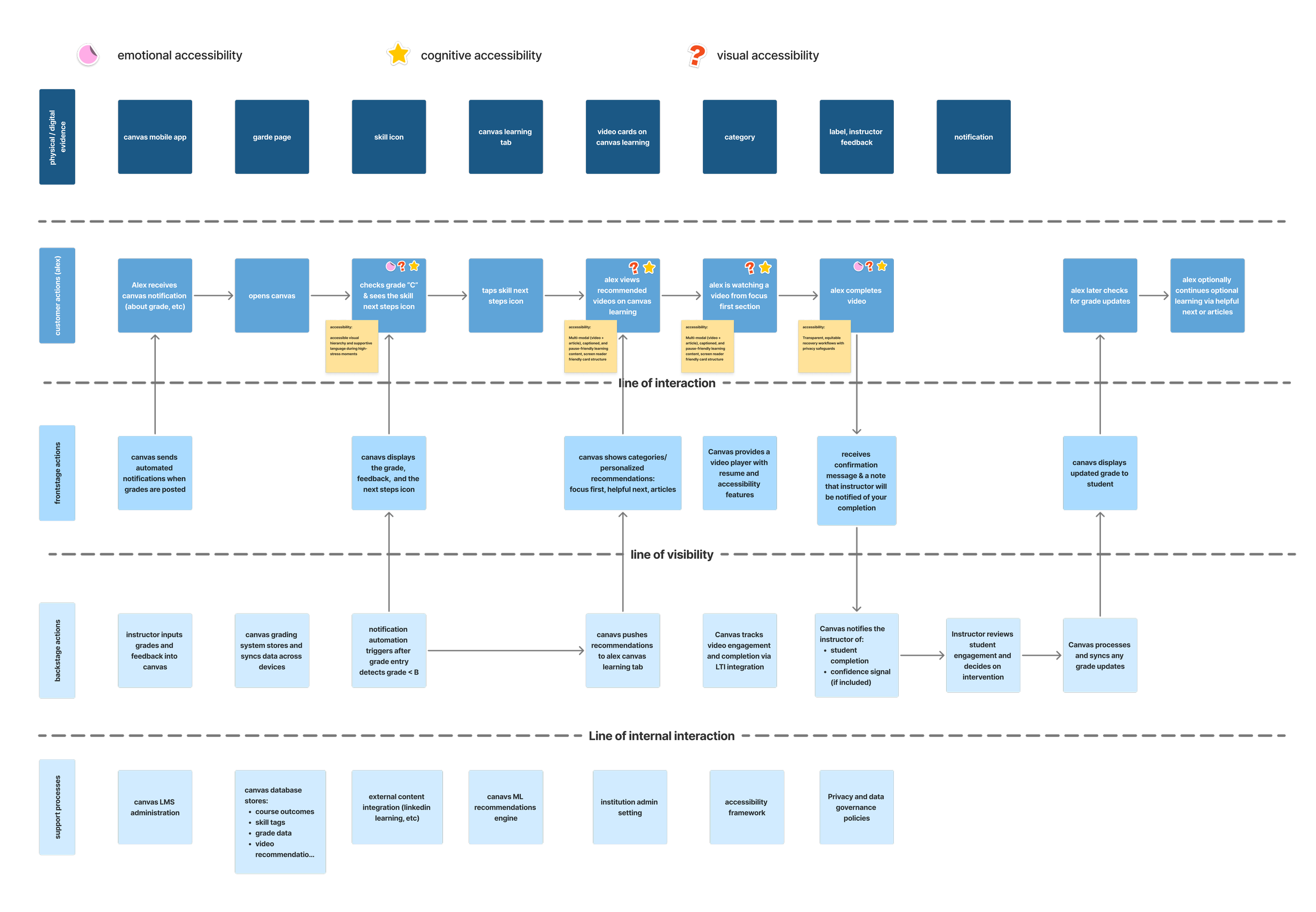
Designed within real constraints:
Institutional licensing, FERPA compliance, instructor workload limits, and LinkedIn Learning LTI integration. Every backstage decision accounts for these.
The system absorbs complexity so people don't have to.
05 Who It Serves
Three stakeholders. One service.
Students
Immediate next steps after receiving feedback no waiting, no switching platforms
Self-paced remediation that reduces anxiety after low grades
Equitable access every student gets high-quality learning materials, not just those who ask or have extra time
Supports ADHD, ESL, and neurodiverse learners through clear categorization and accessible formats
Instructors
No approval bottlenecks - content is pre-approved and compliant with university IT and copyright policies
No manual resource hunting - Canvas handles matching, prioritizing, and tracking automatically
Faster visibility into student struggles, which skills, which videos, and whether Focus First was completed
More focused office hours - students arrive having already attempted self-improvement
Institutions
Consistent learning support across all departments
Better retention and academic outcomes
Uses existing systems - LTI integration installed once, used everywhere
Compliant, scalable infrastructure with SSO and institution-managed credentials
06 Accessibility
Accessibility was part of the design process
I conducted an accessibility audit across four WCAG dimensions: perceivability, operability, understandability, and robustness.
Key decisions:
Captions and transcripts required for all external video content
Focus First kept at top of page with high salience — supporting ADHD users
Plain language explanation under Focus First: "These videos are selected because your recent grade indicates a gap in this skill"
Optional confidence check — passive, no forced surveys
In-Canvas embedded players to avoid tracking loss
07 Reflection
What I learned and where I'd take it next.
What I learned
Designing at the service level means thinking about people who never touch the interface: IT teams, licensing departments, and institution administrators
Every design decision had a backstage consequence
A service can be technically functional and still fail people if the emotional moment of receiving a low grade isn't handled with care
What I'd explore next
Pilot with a real institution to test the instructor approval workflow
Expand the confidence check into a feedback loop that improves recommendations over time
Explore how Canvas Learning translates to community colleges, graduate programs, and professional certifications